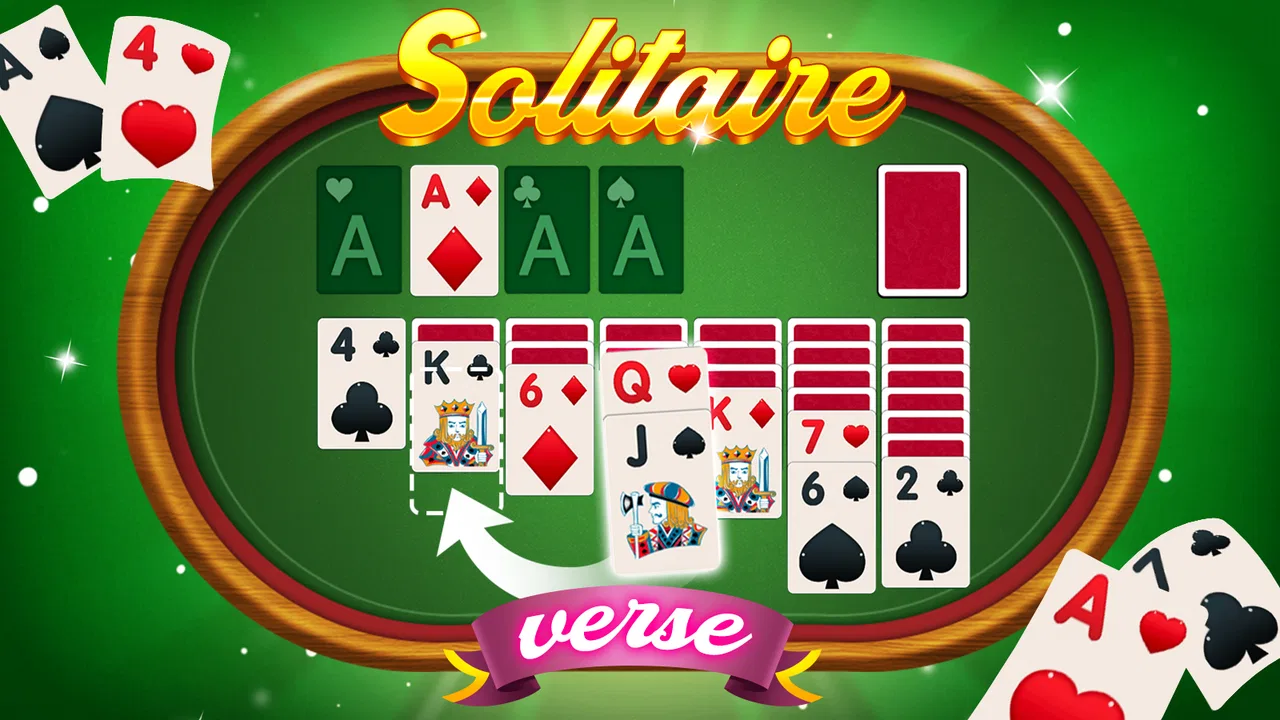
Solitaire Verse
- 4.6
- Rating
- 5.00M
- Installs
- Free
- Price

 Analysis by App-foxy
I usually judge a solitaire game by what happens after the first few relaxed sessions. Almost any familiar card game can feel pleasant on day one, but the more important question is whether it still deserves a place on my phone when the novelty has gone. Solitaire Verse makes a strong first impression because it focuses on the classic card game rather than trying to turn it into something unrecognizable. In my experience, that simplicity is both its main attraction and the reason some players may eventually want more.
Developed by Gimica GmbH, this free card game is aimed at people who want a quick, familiar way to play solitaire on Android. It is rated for Everyone, so the presentation is accessible to a broad audience, including casual players who do not want a complicated ruleset to learn. The game has built a substantial audience, with over five million installs, an average rating of 4.6 from around 310 thousand ratings, and roughly 13 thousand written reviews. Those figures suggest that it is not merely a temporary curiosity; many players find the basic experience useful enough to keep around.
How Solitaire Verse Holds Up Beyond the First Week
I’d use this section to look beyond the easy first sessions and consider whether the game still fits into ordinary routines once its familiar card play becomes less novel. The useful test is not how long I can keep playing, but whether its simple, low-pressure format remains a welcome choice among the other ways I spend a short break.
You May Also Like

 AccuWeather: Weather Radar
AccuWeather Review: A Quick, Clear Forecast for Everyday Decisions
For everyday plans, the best forecast is the one you can understand quickly. AccuWeather makes rain timing, radar, and local conditions easy to act on, with a few trade-offs.

 Hill Climb Racing
Why Hill Climb Racing Still Turns Crashes Into One More Run
A tiny car, a bumpy hill and one more upgrade: Hill Climb Racing keeps resurfacing because its simple chaos makes every near-miss feel personal.

 AliExpress - Shopping App
AliExpress Makes Global Shopping Feel Personal, but Shoppers Bear the Risk
AliExpress turns a global marketplace into a pocket-sized discovery engine. Its reach is useful, its shopping loop compelling, and its trade-offs easy to miss.

 Lords Mobile: Kingdom Wars
Lords Mobile Is a Kingdom-Building Routine, Not a Quick Match
A case-by-case verdict on the building, battles, device demands, and social commitments that make Lords Mobile rewarding for some players and exhausting for others.

 PDF Scanner app - TapScanner
TapScanner Makes Paperwork Easier to Capture, Check, and Share
TapScanner makes scanning with a phone feel less like a rescue operation and more like a dependable step in getting work done. Its capture tools are useful, though not flawless.

 Block Blast!
 Shows How Much a Puzzle Game Can Leave Out
A quiet grid game shows why puzzle players increasingly value instant clarity, repeatable skill and low-pressure play—and where the genre still needs to catch up.
More From Our News Desk
View All News


A familiar start with almost no learning curve
The first-week appeal is easy to understand. Classic solitaire is one of those games I can start without preparing myself for a long session. I already know the general objective, the rhythm of revealing cards, and the satisfaction of gradually clearing the layout. That makes this a good choice for a short break, a quiet evening, or those moments when I want something interactive but not mentally demanding.
Because the game is centered on a well-known card format, Solitaire Verse does not need a lengthy tutorial to justify itself. A new player can begin with the rules they already know, while someone returning to solitaire after years away can settle in quickly. I appreciate that kind of directness. It avoids the common problem of a casual game surrounding a simple activity with too many menus, currencies, missions, or distractions.
That straightforward design also makes it suitable for different levels of attention. I can play carefully when I want to think through each move, or use it as a gentle activity while taking a short mental break. It is not a game that demands a large uninterrupted block of time, which is one of its most practical strengths.
Why the classic format remains effective
Solitaire works because every move offers a small decision without creating pressure. I am constantly balancing immediate progress against the possibility of exposing a more useful card later. Even a simple deal can make me pause and consider whether I am opening a column too soon, moving a sequence for the right reason, or preserving flexibility for the next reveal.
That makes the game more durable than a purely passive time-killer. It gives my attention something modest to do, but it does not punish me with a complicated system. For older phones and players who prefer uncomplicated entertainment, this low barrier is valuable. The minimum operating system is Android 7.0, which keeps the game available to a wide range of devices without requiring a recent handset.
One useful habit is to treat each move as a question about future options rather than immediate appearance. If I can choose between uncovering a hidden card and building a longer visible sequence, I usually favor the move that reveals information, provided it does not close off several later choices. This approach makes the familiar format feel more thoughtful and helps reduce careless losses.
What I would expect during regular daily use
After the first week, the game’s value depends less on surprise and more on convenience. I can imagine keeping it installed for the same reason people keep a deck of cards nearby: it is ready when I need a quiet, self-contained activity. A realistic everyday use would be opening a deal during a commute break, playing one round while waiting for an appointment, and closing it without feeling that I have abandoned a larger obligation.
It also fits well into a wind-down routine. I would not choose it when I want a story, a competitive challenge, or a strong sense of progression. I would choose it when I want to slow down and focus on a small sequence of decisions. That distinction matters because solitaire is most satisfying when I accept its modest scale instead of expecting it to behave like a full-featured strategy game.
For someone deciding whether to install it, the key question is simple: do you want classic solitaire specifically, or are you looking for a broader card-game package? If the former is true, the free price removes much of the risk. If you need several card variants, social play, tournaments, or a deep reward structure, this may feel too narrow once the initial familiarity wears off.
Where the month-to-month value comes from
Longer-term value comes from repeatability. A solitaire deal can be familiar in structure while still requiring different choices each time, and that variation is enough for many players to return. I find the strongest recurring appeal in the game’s ability to fill small gaps in the day without demanding commitment. It is a practical habit game, not a destination game.
That difference helps explain why the title has remained visible since its release on November 16, 2021. A classic format can age well when it stays easy to access and does not require the player to remember a complicated system. I can put it down for several days and return without needing to relearn controls, rebuild a strategy, or catch up on events.
There is also a useful mental rhythm in repeated solitaire sessions. I can begin by scanning the layout, identify the moves that reveal hidden information, and then adjust as new cards appear. Over time, I become more disciplined about avoiding moves that look productive but reduce future flexibility. That personal improvement is subtle, but it gives the game more staying power than simply tapping through random cards.
Small techniques that improve repeated sessions
One technique I find helpful is delaying an automatic-looking move for a moment. Moving a card to a foundation or extending a sequence may seem obviously correct, but sometimes keeping a card available in the tableau gives me more options. I try to ask whether the move improves the position or merely makes it look tidier. That distinction is especially useful when I am playing quickly.
Another practical approach is to use short sessions as deliberate resets rather than chasing a particular number of wins. If I play only until my attention starts to drift, I make fewer impulsive moves and avoid turning a relaxing activity into a frustrating test. Solitaire Verse works well in this role because its core loop is understandable immediately and does not require a long warm-up.
I also recommend changing the purpose of a session. Sometimes I play for a quick completion attempt; at other times, I focus on making the most informative move available. This keeps the classic format from feeling completely automatic. It does not create new content, but it gives the same basic game a slightly different mental texture.
The maintenance burden is refreshingly low
Maintenance is one of the areas where a simple card game can be more convenient than a larger mobile title. Solitaire Verse has a current version of 1.7.1, and the game’s basic identity does not depend on a complicated collection of systems that I need to monitor. I can return to it after a break and understand what I am doing almost immediately.
That low maintenance burden is important for a game intended for casual use. I do not want to manage a roster, remember daily tasks, or feel that skipping a few days has put me behind. A title like this earns space on my phone by being dependable rather than demanding. Its free availability also makes it easy to try without treating the installation as a major commitment.
There is a trade-off, though. Low maintenance can also mean low momentum. Players who enjoy unlocking new abilities, collecting items, or pursuing a changing set of goals may interpret the lack of pressure as a lack of motivation. I see that as a matter of fit, not a flaw that can be judged separately from the intended experience.
Where fatigue can begin
The main source of fatigue is repetition. Classic solitaire is intentionally familiar, so the same quality that makes the game comfortable can eventually make it feel predictable. If I play several rounds in one sitting, the decisions can start to blend together, especially when I am not actively thinking about improving my approach.
This is where expectations matter. I would not install Solitaire Verse as my only mobile game if I wanted constant novelty. It is better as a reliable side activity than as a central hobby. Its recurring value is strongest in short, occasional sessions; it becomes weaker when I demand fresh surprises every time I open it.
Another possible source of friction is the absence of a broader purpose in the core format. A win is satisfying, but it may not lead to a meaningful new objective. For some players, that is ideal because it keeps the game clean. For others, it may make the experience feel disposable after the first enthusiasm fades. I would skip it if I know I need strong progression to stay engaged.
Who should choose it, and who should look elsewhere?
I would recommend this game to someone who wants a recognizable solitaire experience, quick sessions, and a low-pressure way to occupy spare minutes. It is particularly suitable for players who dislike complicated mobile interfaces and want a card game they can understand without studying a manual. The Everyone rating also makes it an approachable choice for households with different ages and gaming habits.
I would be more cautious about recommending it to a player who wants multiplayer competition, a large selection of card variants, or a constantly changing set of objectives. In those cases, a broader card-game app may offer better long-term variety. Someone who finds repetition tiring should also test the game with short sessions rather than assuming that a familiar format will remain exciting indefinitely.
The comparison with physical cards is revealing. A real deck offers the same basic appeal without a screen, while a phone version is faster to set up and easier to carry. Compared with more elaborate digital solitaire alternatives, Solitaire Verse is likely to appeal because it keeps the focus narrow. That is an advantage when I want convenience, but a limitation when I want customization or a richer surrounding experience.
My practical routine for getting the most from it
If I were introducing a friend to Solitaire Verse, I would suggest starting with one or two rounds rather than playing until boredom arrives. The game is more enjoyable when it remains a small daily option. I would also avoid judging it solely by whether every deal can be completed; the useful part is often the process of weighing choices and noticing where a different decision might have preserved more flexibility.
For a calmer routine, I would play without multitasking for a few minutes, then stop after the round. For a faster routine, I would use it as a waiting-room game and accept that not every session needs to end in a win. These approaches make the title more sustainable because they match its actual strengths instead of forcing it to provide the variety of a much larger game.
It is also worth keeping expectations realistic about updates. The current version is 1.7.1, but the lasting appeal here comes from the card format itself rather than from assuming that every return will bring a dramatic change. I would install it for the dependable core experience, not because I need a game that constantly reinvents itself.
Does it earn permanent space?
My long-term verdict is positive, with one important condition: Solitaire Verse earns permanent space as a utility game, not necessarily as a primary game. It is the title I would keep available for quiet pauses, short breaks, and moments when I want a familiar challenge without a large time commitment. The free entry point and broad device support make that role easy to justify.
What keeps it useful after the novelty fades is its low maintenance and immediate readability. I can return after a gap, understand the layout, and start making decisions. That kind of frictionless access is more valuable than it sounds, especially on a phone crowded with apps that expect regular attention.
Still, I would not pretend that the classic format can satisfy everyone indefinitely. Repetition is built into the experience, and players who need social interaction, dramatic progression, or frequent new mechanics will probably outgrow it. For me, that does not cancel its appeal. It simply defines the right place for it: a dependable, lightweight card game that rewards a few thoughtful minutes and never asks to become the center of my day.
My recommendation is to install it if you want solitaire that stays uncomplicated and easy to revisit. Give it a week of short sessions, then ask whether you are returning because the game genuinely fits your routine or merely because it was convenient to try. If it becomes your quiet fallback for spare moments, it has done its job well. If the repeated layout starts feeling like work, you will know that a wider card-game alternative is a better match.
FAQs for Solitaire Verse
01What is Solitaire Verse and how does it differ from other solitaire games?
Solitaire Verse is a unique twist on the classic solitaire card game, offering a variety of themes and challenges that set it apart from standard versions. With beautifully designed graphics and a range of difficulty levels, it caters to both beginners and seasoned players looking for a fresh experience.
02Is Solitaire Verse available for both Android and iOS devices?
Yes, Solitaire Verse is available on both Android and iOS platforms. This ensures that users can enjoy the game regardless of their device preference. The app is optimized for both operating systems, providing a smooth and seamless gaming experience.
03Does Solitaire Verse require an internet connection to play?
No, Solitaire Verse can be played offline, making it a perfect choice for users who want to enjoy the game without the need for a constant internet connection. However, certain features, such as leaderboard updates and daily challenges, may require online access.
04Are there in-app purchases in Solitaire Verse?
Yes, Solitaire Verse offers in-app purchases. Players can buy additional themes, card backs, and other customization options. While the game is free to download and play, these purchases can enhance the gaming experience by adding more variety and personalization.
05How user-friendly is Solitaire Verse for beginners?
Solitaire Verse is designed with a user-friendly interface that is easy to navigate. It includes a tutorial mode for beginners, ensuring that new players can quickly understand the rules and mechanics. The game also offers hints and undo options to assist players as they learn.
Pros
- Intuitive interface for smooth gameplay.
- Wide variety of solitaire variations.
- Regular updates with new features.
- Offline mode available for travel.
- Customizable card decks and backgrounds.
Cons
- Contains in-app purchases.
- Occasional ads can be disruptive.
- Limited social features.
- Requires iOS 11 or later.
- No multiplayer mode available.

Solitaire Verse
Gallery